
Social Behaviour and Kinship in Wild Assamese Macaques
- Angela Findlay

- Mar 4, 2021
- 2 min read
Updated: Mar 8, 2021
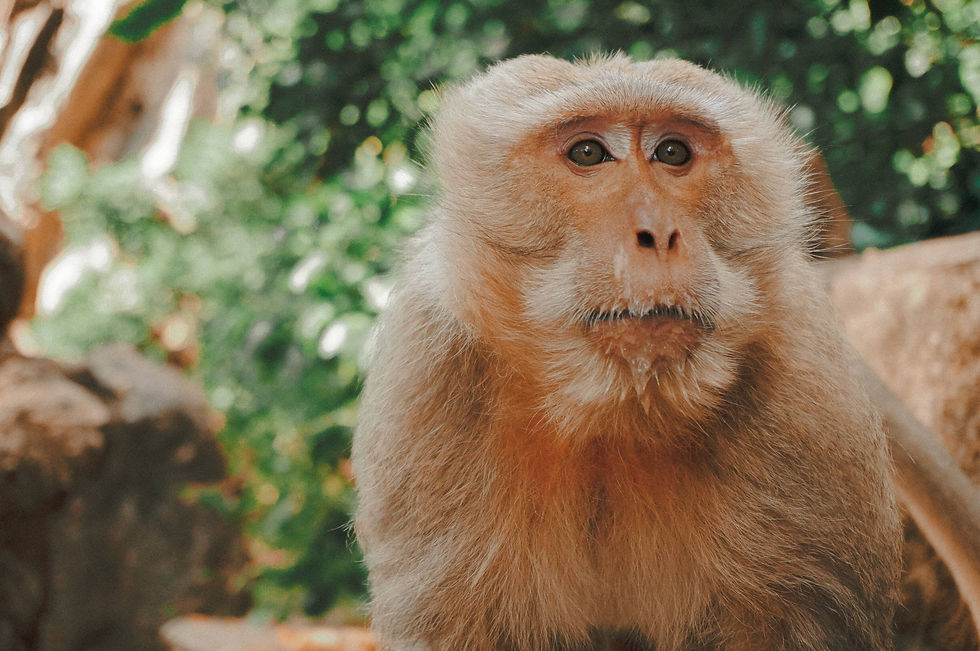
Image Credit: Ahmet Sali (@ahmetsali) | Unsplash Photo Community
We had the pleasure of listening to a talk by Dr Delphine De Moor who is a behavioural ecologist studying the evolution of social relationships, and currently a postdoctoral researcher with Lauren Brent at the Centre for Research in Animal Behaviour of the University of Exeter.
She is part of FriendOrigins, an ERC Consolidator funded project aimed at understanding the evolutionary origins of friendship and maintains the long-term database of behavioural data on wild Assamese macaques at the Phu Khieo Wildlife Sanctuary.

Phu Khieo by Nik Cyclist from Bangkok, Thailand is licensed under CC BY 2.0
Delphine began by introducing the work she did for her PhD about kinship and sociality in the wild Assamese macaque (Macaca assamensis) of the Phu Khieo wildlife sanctuary.
She wanted to address was "How do animals decide who they form social bonds and friendships with?"
A major factor is kinship, kin selection leads to inclusive fitness both direct and indirect and previous information on this comes from studies on maternal kin in females, however paternal kin recognition, unfamiliar kin recognition and kin availability in males are yet to be explained.
"With my research, I aim to understand how forming social bonds impacts individual survival and reproduction, and what drives partner choice in the formation of these bonds"
Study 1 - Paternal Kin Biases in wild Assamese Macaque Females
Life-style:
Multi-male/female groups
Females philopatric, Males disperse
Linear dominance hierarchies
Strong bonds within and between sexes
Data:
Long-term data on 4 groups
59 female & 41 male adults
>21,900 observational hours
Relatedness estimates & parentage assignments - genotyped
Paternal kin biases:
Promiscuous mating hampers paternal kin recognition
Kin discrimination: Inbreeding avoidance & paternal care
Biases in affiliation/co-operation is less pronounced due to less kin recognition
So how do they recognise their paternal kin?
Delphine predicted the relationship strength >maternal kin >paternal kin >non-kin
and no effect of age proximity on paternal kin biases.
Results

Paternal sisters close in age, did not form stronger relationships.
Maternal/paternal kin form stronger relationships than non-kin.
Paternal kin recognition isn't operating through age proximity.
Parent-mediated familiarity?
An important role for the father in the group for the infants, provides male-female/male-infant associations and paternal care
Study 2 - Kin biases in wild Assamese Macaque Males
Male sociality
Strong competition
Affiliation/co-operation
Less kin available in dispersing males
Unfamiliar kin recognition (under debate)

Fitness Benefits
Social bonds
Coalitions
Dominance rank
Reproductive success
Predictions
Few close kin available
Affiliation is kin biased
Non-kin bond as a lack of close kin available
Delphine concluded with the results

No evidence for an effect of close kin availability
Sometimes males chose non-kin over kin to form strong bonds with

Kinship facilitates bonding but is not a prerequisite and bonded males partner in risky coalitions, non-kin can be more competent than actual kin.
My Thoughts
Interesting talk and applicable to many animal species, it would be great to do something like this but I doubt I will.

Delphine is part of the team behind the Animal Behaviour Collective, researchers who organise microgrants & mentorship for undergraduate & graduate students in animal behaviour.


Comments