
Citizens Science & Tiny Forests
- Angela Findlay

- Mar 3, 2021
- 2 min read
Updated: Mar 8, 2021

Image credit: Joshua J. Cotten (@jcotten) | Unsplash Photo Community
Citizens science is the scientific work that is undertaken by members of the public which is overseen by a professional scientist or scientific institution, and has been around for hundreds of years.
It has gained momentum over the past 20 years and its purpose is to help with species conservation.
A few examples of citizen science projects are the big butterfly count, logging sightings of cetaceans for Sea Watch Foundation and the Big Garden Birdwatch

We recently had the pleasure of hearing Daniel Hayhow's presentation about citizen science on our online seminar at Bangor University, he is the Research Lead for Urban Biodiversity at Earth Watch Europe
PART 1
Daniel began with their objective which is to:
Engage the demographic, the community, the public
Enhance and advance science
Broaden scientific mentalities
Literacy in science
Enhance people’s ability to join complex debates in modern problems
Citizens Science is a trusted science, accurate and reliable and being promoted by:
United Nations
European Union
DEFRA
The Environmental Agency
"It is a cost effect way to monitor our environment"
He introduced the 6 key pathways:

Environmental Management
Evidence for policy
Behaviour change
Political advocacy
Social network championing
Community action
and the 4 Approaches.....
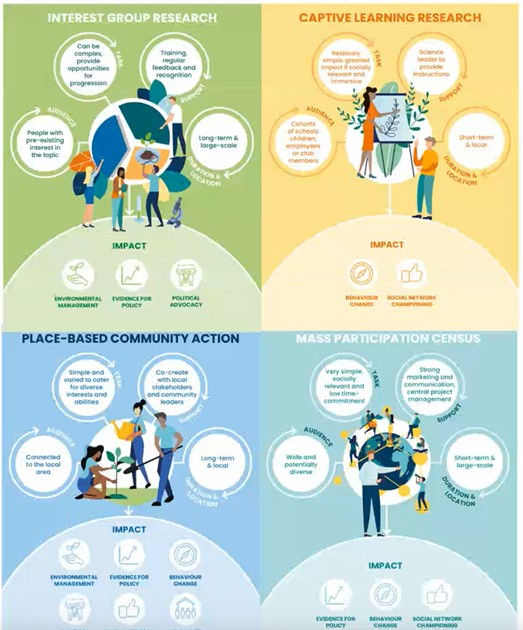
Interest group research
Captive learning research
Place-based community action
Mass participation census
Can citizen science provide data for sustainable development goal indicators?
An example is the testing of water quality by citizens on one site in the UK and another in Zambia.
In the UK the Environment Agency are now working with Earth Watch to build Fresh Water watch into the monitoring that they are doing.
PART 2
Daniel continued onto the 2nd part of his presentation in regard to his own research on urban biodiversity
Cities contribute 70% of greenhouse gas emissions
In 2016 it was found through analysis that Edinburgh, Reading, Bristol and Leeds are 60% green
24% of the 36% of that green land are residential gardens.
In March 2020 Tiny Forests was launched, these are small native woodlands planted in urban areas, they are fast growing, dense with 4 layers, are low maintenance and with a low mortality rate
Working in collaboration with IVN in the Netherlands and with local communities, landowners, councils and business owners to help put them in place
They are monitored through citizens science and these tiny forests will deliver on each of the 6 impacts with future plans to build over 100 in the next 10 years
MORE PROJECTS
Another project is Naturehood which has started in Swindon and Oxford, this takes place in people’s gardens as part of a neighbourhood but not as an individual to encourage people to make a difference and complete surveys.
Want to get involved?
My Thoughts
I really love the tiny forests and I am seriously considering getting involved in this once my course has concluded.

Comments